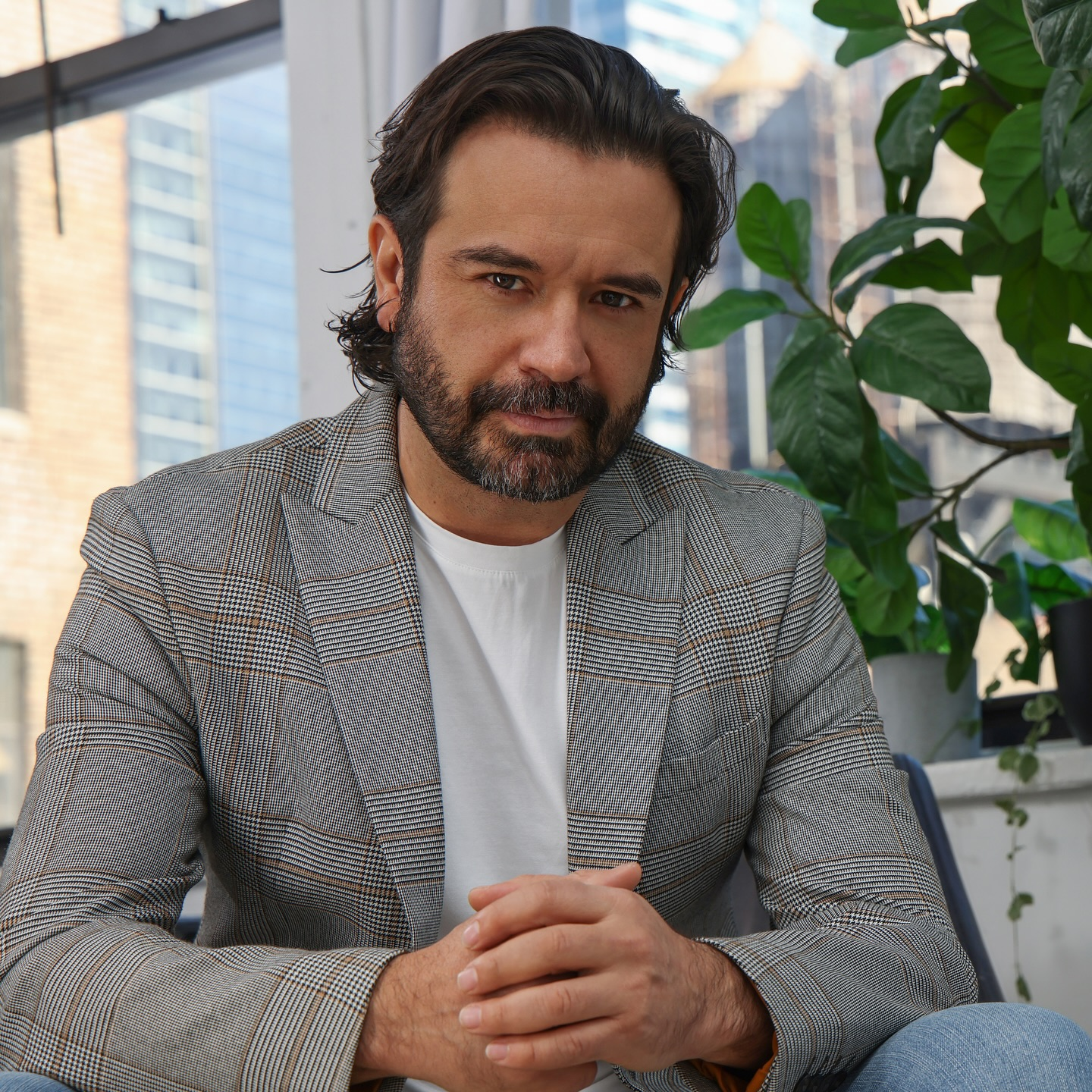

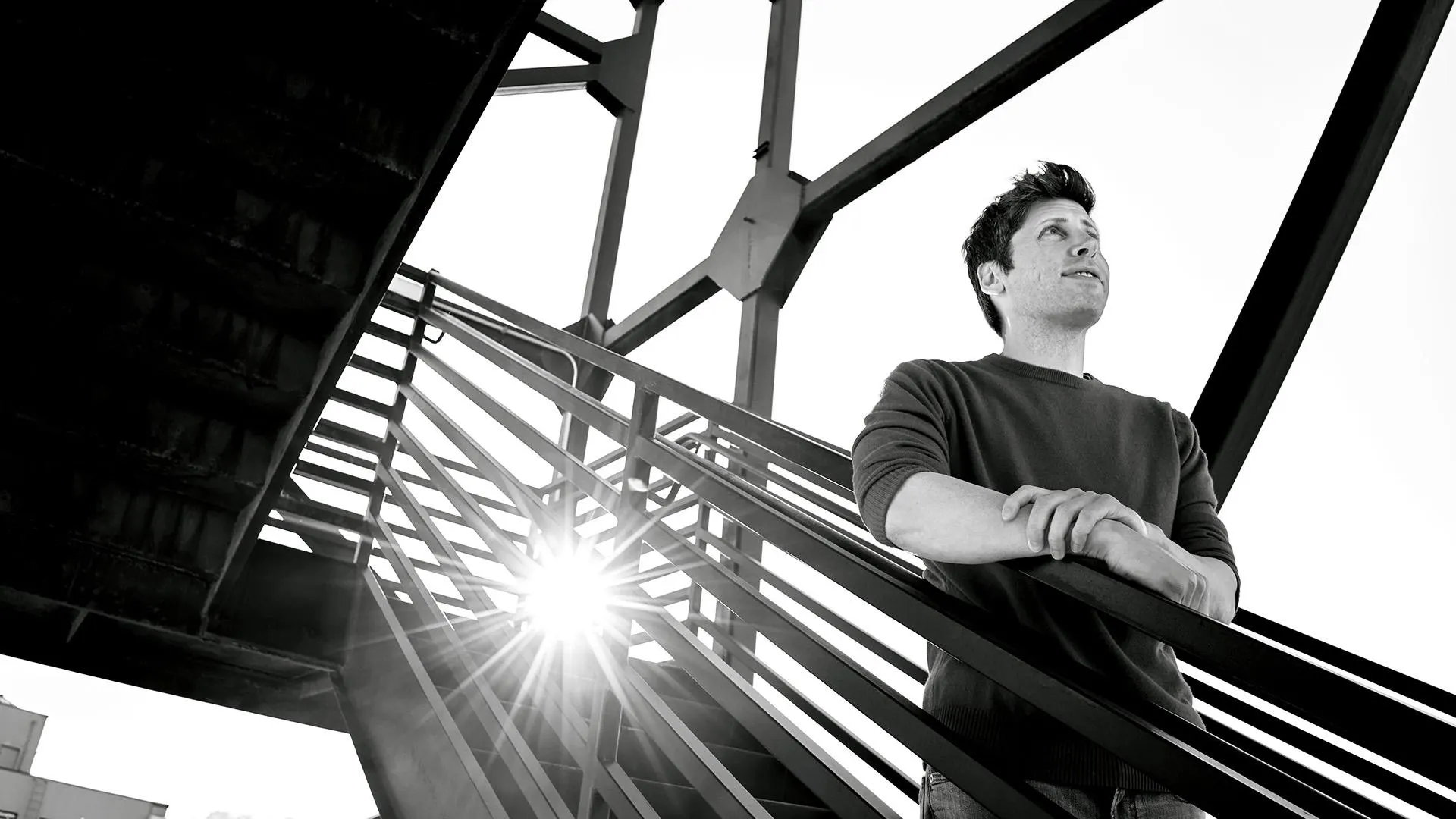
As CEO of OpenAI, the 40-year-old billionaire unleashed ChatGPT, mainstreaming artificial intelligence and creating a $500 billion behemoth. As a new father—with another baby on the way—he’s building the world his kids will live in one day.
Sam Altman says the stick of uranium in his office is nothing to worry about. Sitting vertically on his desk at OpenAI headquarters in San Francisco like a squat ebony Slim Jim, it is perhaps the most eyebrow-raising among the impressive array of historic innovations he has collected over the years. “That’s depleted,” he says casually of the uranium-238 rod, the same element used to create nuclear energy. “It’s not going to hurt you.” He waves a Geiger counter over it and proves his point.
“You make a big discovery in physics and . . . unlock basically unlimited energy,” he says of the uranium rod. “We didn’t know about this, then theorized that such a thing was possible. A couple decades later, they had made an atomic bomb. Just a crazy, fast thing.”
Altman, wearing Adidas Lego Ultraboost sneakers and a simple gray knit sweater, works methodically and chronologically through the artifacts, most of which typically live in his home office, unseen by anyone but his closest friends. On display today, Altman says: a 40,000-year-old hand ax (“an amazing general purpose Stone Age tool”), a 3,500-year-old bronze sword (“an interesting example of technology having a big geopolitical impact”) and a compressor fan blade from a Concorde jet engine (“the only piece small enough” to carry in). In casual defiance of museum curator protocol, he has lugged all these items to his office in a duffel bag, individually wrapped in bathroom towels.
“I am consistently amazed by how much each generation builds a new layer of scaffolding,” he says of technological progress. “We’re really seeing that now.”
As memorable as the uranium rod is, one of the other striking items in Altman’s collection is an old GPU chip. It trained an early version of the model behind OpenAI’s signature product, ChatGPT, which catapulted AI into the mainstream in November 2022 and set off a chain reaction of innovation that may turn out to be as transformative as the Industrial Revolution.
America has a storied history of innovators who aren’t known for inventing, whose achievement instead was pushing the cutting edge into daily life by sheer force of will and wits. Think Steve Jobs, Bill Gates and Elon Musk. Thomas Edison didn’t invent the light bulb. He—or rather his team—improved it with a longer lasting filament and then aggressively brought it to market.
Altman is of that mold. He’s an investor and an accelerator more than an engineer or a scientist. His vision isn’t about perfecting consumer products—it’s about building the underlying systems that the rest of the economy may soon depend on. ChatGPT now has more than 800 million weekly users. OpenAI, with more than $13 billion in revenue last year, was recently valued at $500 billion (Altman has no direct equity stake in the company, but his other investments make him worth an estimated $3 billion). It’s currently in talks to raise an additional $100 billion in a megaround that could value it at $750 billion or more. Inspired by OpenAI, big tech could pour an estimated $500 billion into AI data centers and chips this year. At this moment, it is perhaps the most important company in the world.
That has made Altman, now 40, the subject of a fast-growing hagiography. Disney CEO Bob Iger says Altman can “look around corners” to see the future. Airbnb cofounder Brian Chesky calls him “one of the two most ambitious people I know” (the other being Musk). Apple design legend Jony Ive says enigmatically that Altman “is comfortable with the unknown, but he is not casual about the responsibility.” Renowned VC Paul Graham (Altman’s former mentor at the startup incubator Y Combinator) offers a balder take: “He’s good at convincing people of things. He’s good at getting people to do what he wants.”
Though soft-spoken with a low-key Midwestern demeanor, Altman is something of an AI carnival barker. His aggressive predictions about the technology’s exponential growth need to come true to justify not just OpenAI’s valuation but the vast economic and social bets forming around it. And it’s not clear he quite knows how to get there. Can he deliver on a future as big and fast and expensive as the one he describes?
“I think I am unusually good at projecting multiple things— years or a couple of decades into the future—and understanding how those are going to interact together.”Sam Altman, Co-founder, OpenAI
By Richard Nieva, Anna Tong,