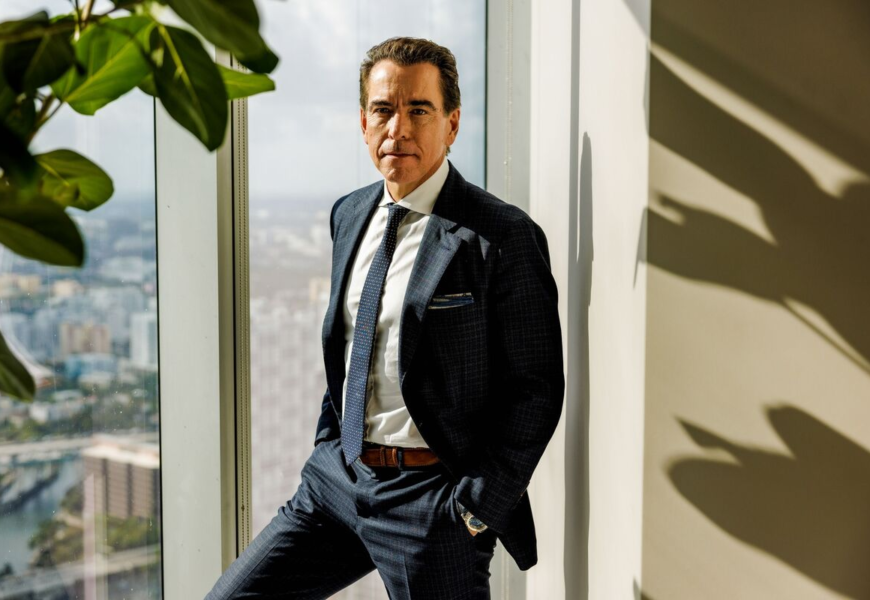
As founder and managing partner of Thoma Bravo, Orlando Bravo has built one of the world’s most influential software investment firms, combining financial discipline, strategic acquisitions, and a long-term vision for value creation.
In the world of global finance, where investment strategies are often shaped by market cycles and short-term expectations, Orlando Bravo has built his reputation on a different philosophy: specialization, operational discipline, and a deep understanding of the businesses in which he invests.
Born and raised in Mayagüez, Puerto Rico, Bravo has become one of the most prominent figures in private equity, helping transform software investing into a major segment of the global financial industry.
As founder and managing partner of Thoma Bravo, he leads an investment firm managing approximately $170 billion in assets as of March 31, 2026, according to the company’s official disclosures.
His influence extends beyond capital allocation. Through decades of acquisitions, strategic partnerships, and operational transformations, Bravo has helped establish a model for investing in enterprise software businesses.
His career also represents an important chapter in Latino leadership within global finance, demonstrating how expertise, conviction, and a long-term investment philosophy can create institutions with international reach.
From Puerto Rico to Wall Street
Bravo’s journey began in Mayagüez, a city on Puerto Rico’s western coast, far from the traditional centers of American private equity.
His academic career took him to Brown University, where he studied economics and political science and graduated Phi Beta Kappa. He later earned both a law degree from Stanford Law School and an MBA from Stanford Graduate School of Business.
This combination of economics, law, and business provided a foundation for navigating complex financial transactions, corporate structures, and investment strategies.
Before establishing himself in private equity, Bravo worked at Morgan Stanley in New York, gaining experience in mergers and acquisitions.
He subsequently joined the investment business that evolved into Thoma Bravo, working alongside veteran investor Carl Thoma.
At a time when many private equity firms pursued opportunities across multiple industries, Bravo recognized the potential of focusing on enterprise software companies.
That decision would become central to his investment career.
Building Thoma Bravo: The Power of Specialization
Thoma Bravo has become one of the largest software-focused private equity firms in the world.
Its investment approach centers on acquiring and partnering with established software and technology-enabled businesses, with an emphasis on improving operations, strengthening competitive positions, and supporting long-term growth.
The firm’s strategy reflects an important distinction between traditional venture capital and private equity.
While venture capital typically finances emerging businesses with significant growth potential, Thoma Bravo frequently invests in more mature companies with established customers, recurring revenue, and opportunities for operational improvement.
Enterprise software proved particularly attractive because many businesses depend on these products for essential functions, creating customer relationships that can generate predictable revenue.
Bravo helped recognize the investment potential of this business model before software-focused buyouts became a widely established private equity strategy.
Under his leadership, Thoma Bravo has overseen approximately 600 software and technology acquisitions, representing around $325 billion in aggregate transaction value, according to company figures.
The firm’s growth reflects not only its ability to deploy capital but also its commitment to a specialized investment thesis.
Rather than attempting to master every industry, Bravo built an organization around developing deep expertise in one sector.
The Investment Philosophy: Discipline Over Hype
One of Bravo’s defining characteristics as an investor is his emphasis on business fundamentals.
In an industry frequently influenced by market sentiment, technological excitement, and changing valuations, his approach prioritizes the underlying economics of a company.
Profitability, customer retention, operational efficiency, cash generation, and the sustainability of revenue are central considerations.
For Bravo, a successful acquisition is not simply about purchasing a company at an attractive price. It is about understanding how that business operates and identifying opportunities to improve its performance.
This philosophy has become particularly relevant as the technology industry navigates artificial intelligence, evolving software business models, and uncertainty around valuations.
In a June 2025 interview with Axios, Bravo emphasized focusing on the performance of individual businesses rather than attempting to predict every macroeconomic development.
The principle is straightforward: investors can exercise greater influence over business operations than over global economic conditions.
Thoma Bravo’s investment strategy reflects that philosophy through a combination of financial analysis, operational expertise, and collaboration with management teams.
However, private equity’s approach also invites scrutiny. The industry’s use of leverage, cost restructuring, and pressure to deliver investment returns can create tensions between financial performance and the interests of employees, customers, and other stakeholders.
The long-term success of the model depends on whether operational improvements create sustainable value beyond the investment holding period.
Technology, Artificial Intelligence, and the Next Investment Cycle
Artificial intelligence is reshaping the global software industry, creating opportunities while challenging assumptions about the future of established technology businesses.
For investors like Bravo, the emergence of AI raises fundamental questions about which software companies will maintain their competitive advantages and how new technologies will affect revenue models.
Rather than treating every technological development as an automatic investment opportunity, Bravo has emphasized the importance of evaluating its actual commercial impact.
In 2026, he also drew attention to the role of stock-based compensation in software valuations, arguing that investors must carefully assess the economic costs associated with equity awards when evaluating potential acquisitions.
His perspective reflects a broader investment philosophy: technological innovation must ultimately be understood through its effect on business performance.
Artificial intelligence may transform how companies operate, develop products, and serve customers, but investment decisions still require financial discipline.
For Thoma Bravo, the challenge is to identify companies capable of adapting to technological change while maintaining sustainable economics.
Leadership Beyond Capital
Managing a global investment firm requires more than financial expertise.
Thoma Bravo’s expansion has involved building investment teams, developing operational capabilities, establishing relationships with company executives, and managing institutional capital across multiple investment strategies.
Bravo’s leadership illustrates the importance of combining a clear strategic vision with an organizational structure capable of executing it.
His approach also demonstrates the value of consistency.
Rather than continually reinventing the firm’s investment identity, Thoma Bravo has built its reputation around a defined area of expertise, refining its methods as the software industry evolves.
That specialization has helped distinguish the firm within a highly competitive private equity market.
Bravo’s influence has earned recognition from major financial publications. In 2019, Forbes described him as “Wall Street’s Best Dealmaker,” highlighting his record in software acquisitions and private equity investing.
Yet the significance of his career extends beyond individual transactions.
He has helped establish software as a major institutional investment category and demonstrated how sector knowledge can become a durable competitive advantage.
Investing in Puerto Rico’s Next Generation
Despite his international business career, Bravo has maintained a strong connection to Puerto Rico.
Through the Bravo Family Foundation, he has supported initiatives focused on entrepreneurship, education, and economic opportunity on the island.
His philanthropic involvement intensified following Hurricane Maria in 2017, when he participated in relief efforts to support affected communities.
In 2019, Bravo announced a $100 million commitment to the foundation’s Rising Entrepreneurs Program, designed to support the development of entrepreneurial talent in Puerto Rico.
The initiative reflects an effort to apply lessons from business and investment to a different challenge: expanding access to opportunity.
Through mentorship, entrepreneurial development, and educational programs, the foundation aims to help emerging founders strengthen their capabilities and build sustainable businesses.
For Bravo, supporting entrepreneurship in Puerto Rico connects his professional expertise with his personal origins.
It also underscores a broader idea about economic development: access to knowledge, networks, and mentorship can be as important as access to capital.
A New Generation of Latino Financial Leadership
Orlando Bravo’s trajectory challenges traditional perceptions of Latino representation in international business.
While Latino entrepreneurs have built influential companies across entertainment, hospitality, real estate, and consumer products, their presence in the highest levels of institutional finance receives comparatively less public attention.
Bravo represents a different dimension of that entrepreneurial influence.
His work takes place in private equity, where decisions about acquisitions, investment strategies, and corporate development can shape entire industries.
His career demonstrates that Latino leadership is not limited to culturally identified businesses or consumer-facing brands.
It also extends into global capital markets, technology ownership, and the financial institutions that influence the direction of the modern economy.
For younger professionals interested in finance, his journey offers an example of how specialized knowledge, education, strategic thinking, and long-term commitment can support an international career.
The Legacy of Strategic Vision
Orlando Bravo’s story is ultimately about recognizing an opportunity, developing expertise, and building an institution around a consistent investment philosophy.
From Mayagüez to the highest levels of global private equity, his career has been shaped by a conviction that disciplined investment and operational execution can create lasting business value.
Through Thoma Bravo, he has played a significant role in the evolution of software investing.
Through his philanthropic work, he has sought to extend entrepreneurial opportunities to the next generation in Puerto Rico.
Both dimensions reflect a belief in the importance of building organizations capable of producing results over time.
Photo by : Scott Mclntyre