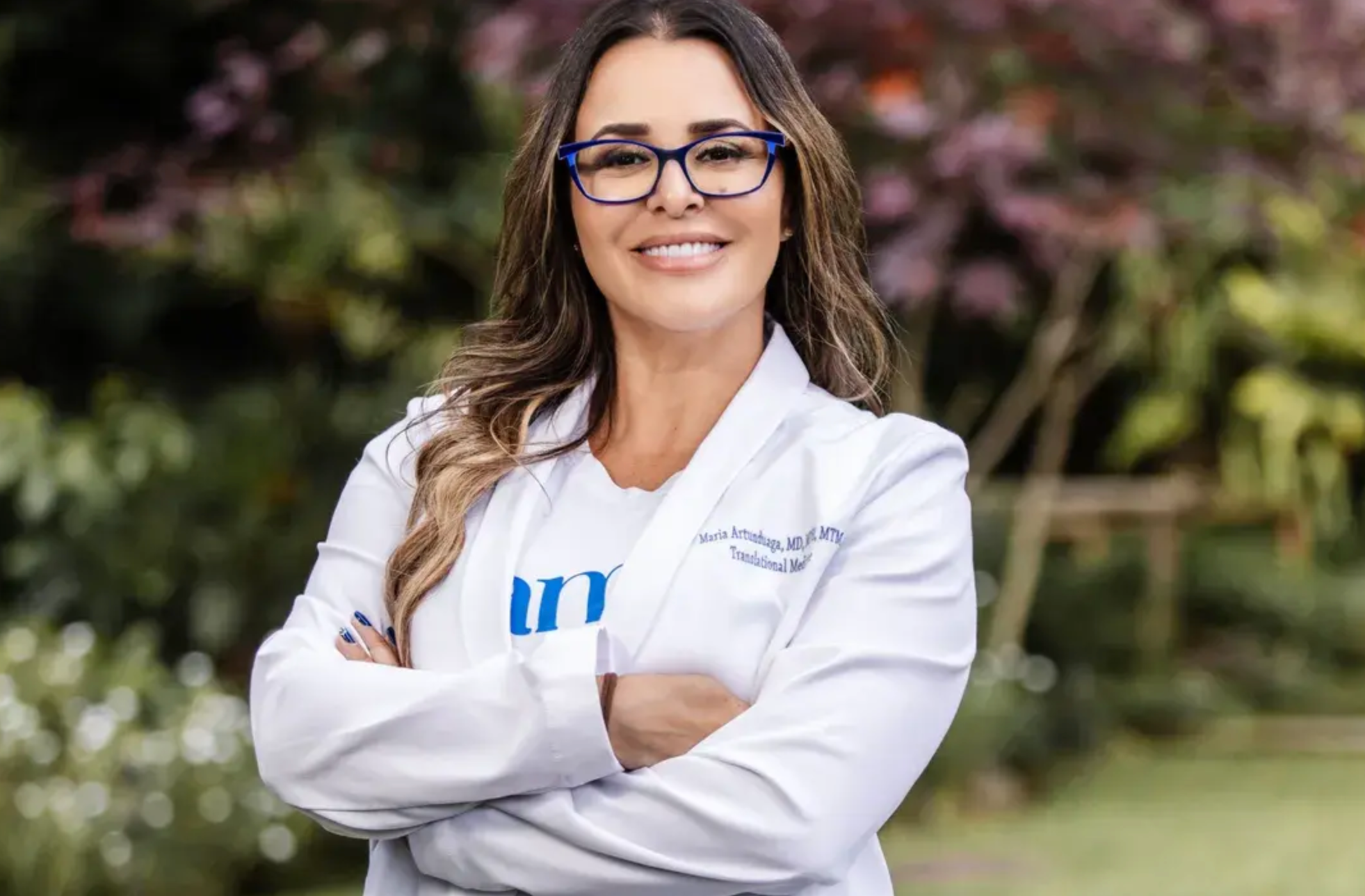
From leaving a promising surgical career to building an award-winning MedTech company, Maria Artunduaga is transforming personal loss into technology that could change how millions of people understand and manage lung disease.
Some of the most consequential innovations begin not in a laboratory or a boardroom, but with a problem that becomes impossible to ignore.
For Colombian physician-scientist, inventor and entrepreneur Dr. Maria Artunduaga, MD, MPH, MTM, that moment came after losing her grandmother, Sylvia, to chronic obstructive pulmonary disease (COPD).
Today, Artunduaga is the founder and CEO of Samay, a medical technology company developing AI-assisted solutions designed to help patients and healthcare providers better understand respiratory health outside the hospital.
Her journey from Colombia to some of America’s leading academic institutions — and ultimately into entrepreneurship — represents the kind of Latino leadership increasingly shaping the future of science, medicine and technology.
When Personal Loss Becomes a Mission
Artunduaga was pursuing a demanding career in medicine and had begun training in plastic surgery at the University of Chicago when her grandmother’s health suddenly deteriorated in Colombia.
Sylvia lived with COPD, a progressive respiratory disease that can make breathing increasingly difficult. Although Artunduaga comes from a family that includes physicians, distance became a critical obstacle. Her grandmother lived hours away, and the family depended largely on conversations with her to understand how she was doing.
By the time the severity of her deterioration became clear, Sylvia required hospitalization and intensive care. She died after developing complications.
The experience fundamentally changed Artunduaga’s trajectory.
Rather than continuing along the career path she had spent years building, she became determined to address a fundamental problem she had experienced firsthand: patients with chronic respiratory disease often lack practical ways to objectively monitor changes in their lung function while they are at home.
Artunduaga left clinical medicine and turned toward invention and entrepreneurship.
The result became Samay — a name derived from a Quechua word associated with breathing deeply.
And its flagship technology would carry another deeply personal name: Sylvee, honoring the grandmother who inspired it.
From Colombia to America’s Innovation Ecosystem
Long before becoming a startup founder, Artunduaga had built an unusually multidisciplinary career.
She earned her medical degree in Colombia before continuing her education and research in the United States. Her trajectory included postdoctoral work at Harvard Medical School, training in plastic surgery at the University of Chicago, a Master of Public Health from the University of Washington and a Master of Translational Medicine through UC Berkeley and UC San Francisco.
That combination of medicine, research, public health and translational science eventually became essential to her work as an entrepreneur.
Artunduaga wasn’t simply trying to create another health application. She was attempting to rethink how respiratory function could be measured outside traditional clinical environments.
Building Technology That Listens to the Lungs
At the center of Samay’s work is an idea that sounds deceptively simple: use sound to better understand what is happening inside the lungs.
The company’s technology uses acoustic signals and artificial intelligence to analyze respiratory function without requiring patients to perform the forceful breathing maneuvers traditionally associated with pulmonary function tests.
Sylvee is being developed as a non-invasive wearable capable of collecting respiratory information while a patient goes about everyday life.
According to MedTech Color, the technology has been tested in hundreds of subjects and has demonstrated accuracy of up to 98% in detecting respiratory conditions and biomarkers in testing. Samay’s broader vision is to give physicians a more continuous picture of what is happening between medical appointments — potentially identifying deterioration before it becomes an emergency.
For people living with chronic respiratory disease, that distinction could be significant.
It is also where Artunduaga’s experience as a physician becomes inseparable from her work as a founder.
She understands both sides of the problem: what clinicians need to make decisions and what patients experience when sophisticated medical infrastructure is no longer within reach.
Innovation With an Access Mission
Artunduaga’s vision extends beyond developing a successful medical device.
It addresses one of healthcare’s persistent inequalities: geography.
Specialized pulmonary care is not equally accessible across the United States, particularly for patients in rural and underserved communities. Chronic respiratory diseases can therefore become not only medical challenges but access challenges.
Technology capable of collecting meaningful respiratory information remotely could potentially expand the reach of telehealth, support physicians managing patients from a distance and provide researchers with new ways to understand disease progression outside controlled clinical settings.
It is a problem Artunduaga understands personally.
Distance played a role in her family’s inability to recognize her grandmother’s deterioration in time. Now, eliminating some of that distance between patients and healthcare providers sits at the heart of the company she created.
From Startup Founder to Award-Winning Inventor
The medical technology industry has taken notice.
In 2024, Samay won the MedTech Innovator Global Competition, one of the world’s leading accelerators and competitions for medical device and digital health companies. Artunduaga became the first Latina physician to achieve the distinction, while Samay made history as a Latino-led company in the program.
The recognition marked an important transition.
Samay was no longer simply an ambitious startup trying to prove an unconventional approach to respiratory monitoring. It was emerging as a serious MedTech company with independently recognized technology.
The company’s intellectual property portfolio has expanded as well. By 2026, The Lemelson Foundation reported that Samay had grown from a single prototype to a company with 18 patents and another 19 pending.
Artunduaga herself has accumulated more than 50 awards for her work as a physician-scientist and inventor, while her scientific work has appeared in major publications.
Her recognition has expanded beyond medicine. She was included on Inc.’s Female Founders list in 2025 and among Bloomberg Línea’s 100 Innovators in Latin America.
But those accolades tell only part of the story.
A Different Model of Latino Leadership
Artunduaga’s trajectory represents something larger than the success of one founder.
For decades, Latino achievement in the United States has often been framed around a relatively narrow group of highly visible industries. A new generation of Latino leaders is expanding that narrative into artificial intelligence, biotechnology, medicine, engineering, venture-backed entrepreneurship and deep technology.
Artunduaga belongs squarely within that generation.
She arrived in the United States from Colombia as a physician pursuing advanced training and ultimately moved through Harvard, the University of Chicago, the University of Washington, UC Berkeley and UCSF before becoming the founder of a technology company.
But perhaps the most remarkable part of her story is not the institutions attached to her résumé.
It is her willingness to walk away from a prestigious and carefully constructed career when she believed there was a more important problem to solve.
Entrepreneurship required her to become more than a doctor or scientist. She had to become an inventor, fundraiser, executive, team builder and advocate for an entirely new approach to respiratory medicine.
That transition also speaks to a characteristic she frequently emphasizes: resilience.
Innovation rarely moves in a straight line. Medical technology in particular requires navigating scientific validation, intellectual property, financing, engineering, clinical research and regulatory hurdles — often simultaneously.
For Artunduaga, those obstacles have become part of the process rather than reasons to abandon the mission.
Building Something Bigger Than a Device
Samay’s potential ultimately goes beyond Sylvee.
The larger opportunity is the creation of a platform capable of generating meaningful respiratory data continuously and outside the traditional healthcare setting.
That information could eventually have value not only for patients and physicians but also for pharmaceutical companies, medical technology developers and researchers studying how respiratory diseases progress and respond to treatment.
In that sense, Artunduaga is working toward something much larger than a wearable.
She is attempting to change where respiratory health can be understood.
Instead of waiting for the patient to arrive at the hospital, the technology could help bring a portion of the hospital’s diagnostic intelligence to the patient.
It is an ambitious idea born from an extraordinarily human experience.
Years ago, Maria Artunduaga and her family could speak to Sylvia on the phone, but they could not see what was happening inside her lungs.
Today, Artunduaga is building technology designed to make those invisible changes measurable.
Her grandmother’s life could not be saved.
But the company carrying her legacy may help other families recognize the warning signs sooner.
And that transformation — from loss to invention, from immigrant physician to technology founder, and from personal mission to potentially global impact — makes Maria Artunduaga one of the Latino innovators redefining the future of healthcare.